
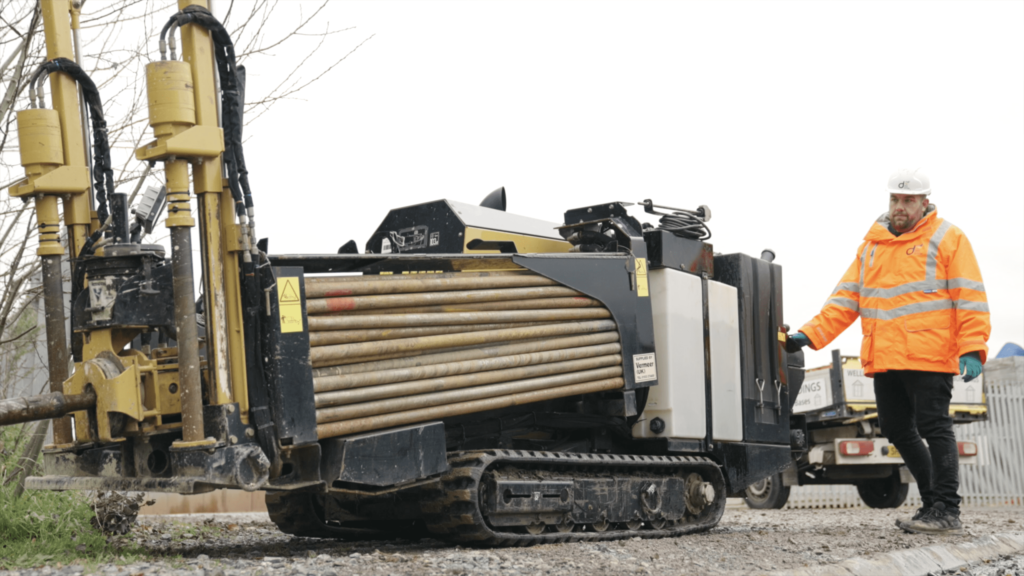
Traditional open-cut trenching has long been the standard for installing utilities, but it comes with a high price: traffic disruption, environmental damage, and costly surface restoration. Horizontal Directional Drilling (HDD) has emerged as the premier “trenchless” alternative, allowing for the installation of pipes and cables with minimal surface impact.
The Three-Stage Process
HDD is a highly engineered process consisting of three distinct phases:
- The Pilot Bore: A small-diameter hole is drilled along a predetermined path. The drill head is tracked from the surface using electromagnetic sensors, allowing the operator to steer around obstacles like existing sewers or rock formations.
- Pre-Reaming: Once the pilot bit reaches the exit pit, it is replaced with a “reamer.” This tool is pulled back through the hole to enlarge it to the required diameter—often up to 900mm for large mains.
- Pipe Pull-Back: Finally, the product pipe (often HDPE or steel) is attached to the reamer and pulled through the lubricated borehole to its final position.
Environmental and Social Benefits
Because HDD requires only small entry and exit pits, the environmental footprint is significantly reduced. This is particularly vital when working in Sites of Special Scientific Interest (SSSI) or Root Protection Zones (RPZ). Trenching through a forest can kill a tree by severing its root system; HDD allows you to dive deep beneath the roots, leaving the landscape untouched.
In urban environments, the “social cost” of construction is a major factor. Traditional digging requires road closures, which leads to traffic congestion and lost revenue for local businesses. HDD allows for “business as usual” above ground while the work continues silently below.
Versatility Across Industries
Directional drilling is now the industry standard for:
- Telecommunications: Fast-tracking fiber-optic rollouts.
- Renewable Energy: Connecting wind farms and solar parks to the grid.
- Water and Gas: Replacing aging mains with minimal disruption.
- Pumped Sewer Lines: Navigating the specific gradients required for wastewater management.
With the ability to achieve single drill lengths of up to 1,000 meters, HDD is no longer just for crossing roads—it is a viable solution for major cross-country infrastructure.